The Public Smile Is Not the Whole Story
The public smile is not the whole story: learn to read an athlete’s visible performance without mistaking it for a full account of private feeling.
The most common mistake is treating an athlete’s smile after a match as a reliable report of how they feel. The public smile is not the whole story; it may cost the athlete privacy when a brief, visible moment is taken as proof of confidence, happiness or ease.
A camera catches a face, a gesture or a few words. It does not show the conversation that came before, the effort required to take part, or what the athlete chooses to keep private. A more thoughtful response is not to guess harder, but to separate what you saw from what you think it means.
Start with the visible moment, not the assumed feeling
After a win, an athlete might grin for a photograph, thank supporters and join a team celebration. Those actions show that they smiled, spoke and took part in the celebration. They do not, by themselves, establish how the athlete felt once the camera moved away.
The same restraint applies to a loss. A player who looks composed may be disappointed, relieved, exhausted or focused on a practical next task. Another who cries may welcome the chance to show emotion, or may simply be unable to hold it back. A single expression cannot tell you which account is true.
Try describing the moment without adding an interpretation: “She thanked the crowd and smiled during the interview.” Compare that with “She was delighted with the result.” The first reports observable behaviour; the second claims access to an inner state that the behaviour alone cannot confirm.
Use a week-long routine for reading public moments
You do not need a complicated rule for every interview or photograph. A simple routine across a week of sport can help you notice the difference between an athlete’s public actions and the feelings you are tempted to assign to them.
- When you first see a clip, record the observation. Note what the athlete said or did, rather than assigning a mood. “He sat quietly at the press conference” is an observation; “He was angry” is an inference.
- Later that day, look at the setting. Was the moment a post-match interview, a team photograph, a sponsor appearance or a brief exchange with supporters? The setting helps explain why the athlete was visible, but it still does not disclose everything they felt.
- On the next day, check what the athlete actually chose to share. If they have spoken publicly about a reaction, stick to the scope of that statement. Do not turn a comment about one match into a diagnosis of their broader wellbeing.
- When the story appears again, separate reporting from repetition. A headline may repeat an earlier interpretation rather than add new information. Ask whether the athlete has offered a fresh account, or whether the same facial expression is being recirculated.
- By the end of the week, decide what you can reasonably say. Keep confirmed details, mark uncertain readings as uncertain, and leave private matters unfilled. If the athlete has not explained a feeling, “we do not know” is a complete answer.
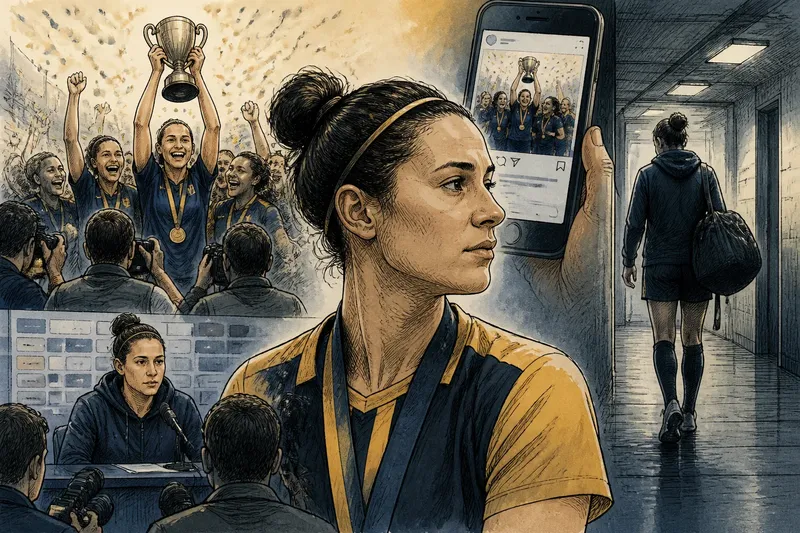
Say you watch an invented post-match clip in which a captain raises a trophy, smiles for a group photograph and later leaves without speaking to reporters. You could describe those visible actions and note that no explanation was given for the departure; you should not present either happiness or distress as fact. The expected result is a more accurate account that does not turn a short appearance into a private story.
Notice how different settings shape a public face
Athletes often meet audiences through settings with their own demands. A broadcast interview may require a concise answer under bright lights, while a team celebration invites a shared gesture. A sponsor event may involve posed photographs; a social media post may be carefully chosen and edited. Each setting gives you a different view, not unrestricted access to the person.
Routine can also affect appearance. An athlete may be tired after travel, concentrating on a coach’s instructions, or trying to stay composed before another commitment. These possibilities are not explanations unless the athlete provides them. They are reminders that a visible expression can have several plausible causes.
Notice what changes across contexts without turning the comparison into a verdict. If someone is animated with teammates but quiet in an interview, you can say their manner differed between those settings. You cannot conclude that one version is fake and the other reveals their “real” self.
Keep public comments within their stated limits
When athletes discuss pressure, disappointment or joy, use their own words carefully. A comment about feeling nervous before one performance does not establish that the person is always anxious. A statement that they enjoyed a win does not require them to be happy in every photograph that follows.
Paraphrase only what the athlete has made public, and keep the context attached. If they say they were pleased with the team’s effort but frustrated by their own performance, preserve both parts. Selecting only the upbeat phrase can make a complicated reaction sound simpler than it was.
Keep questions within the boundaries the athlete has set, too. If they decline to discuss a personal matter, do not treat that refusal as evidence of a hidden crisis or an invitation to speculate. Silence may mean only that they do not wish to speak about it publicly.
Why can an athlete smile while feeling something else?
Does a smile mean an athlete is happy?
Not necessarily. A smile may be a greeting, a response to a teammate, a habit in front of cameras or an expression of genuine happiness; the visible gesture alone cannot distinguish among them.
Can a calm interview show that a player is unaffected?
No. A calm interview shows how the player appeared in that setting. It does not establish the strength, absence or duration of any private reaction.
What should I do when an athlete’s expression seems to contradict their words?
Report both the words and the observable expression without claiming to know which is more authentic. If the athlete has not explained the apparent difference, leave the tension unresolved rather than inventing a motive.
Is it fair to describe an athlete as emotional after one clip?
It is more precise to describe the particular action, such as crying during an interview or celebrating with teammates. A broad label can turn a brief moment into a fixed judgement about the person.
Choose language that leaves room for privacy
Use verbs that describe what happened: smiled, paused, applauded, answered, left or declined to comment. If you interpret a moment, make the distinction clear with wording such as “appeared pleased” or “may have been frustrated”, and avoid repeating an inference until it starts to sound confirmed.
Be especially careful when a clip is short or detached from its original setting. A pause can be edited out of a longer answer; a reaction can be replayed without the conversation around it. Before sharing a strong claim, check the full interview or a reliable report where possible. If the context is unavailable, say so rather than filling the gap.
That discipline matters in ordinary fan conversation as well as journalism. A friend might point to a player’s grin and say they must be delighted, or interpret a blank expression as arrogance. You can keep the conversation grounded by asking what the athlete actually said and acknowledging what remains unknown.
Respect the boundary between attention and access
Being watched is part of public sport, but visibility does not make every private feeling public property. An athlete can share a reaction without owing an account of every part of it. Readers can care about the person and still accept that some details are theirs to keep.
When you next see a familiar smile after a match, let it remain what it is: a visible moment. The public smile is not the whole story, and a careful reader does not need to complete the unseen parts. That small pause before drawing a conclusion makes space for the athlete’s own account, if they choose to give one, and for privacy if they do not.